Wednesday, November 30, 2005

Saturday, November 26, 2005
The Pallasites of Kiowa County
If you're reading this thinking it's a story about inbred hillbillies in rural Kansas, move on to the next blog. But if you think rocks that crash to Earth from outer space are really cool, then check out the Million Dollar Space Rock that Steve Arnold found.

To give you an idea of how beautiful this lump of rock they're sitting on really is, here's a photo of one that's been cut open and polished...

(thanks to Monnig Museum at TCU)
No more posts today... I've got a shovel and a back yard, I'm gonna find me one of them thangs.
To give you an idea of how beautiful this lump of rock they're sitting on really is, here's a photo of one that's been cut open and polished...
(thanks to Monnig Museum at TCU)
No more posts today... I've got a shovel and a back yard, I'm gonna find me one of them thangs.
Tuesday, November 22, 2005
Second Amendment Target Tour
The Second Amendment Target, having started its journey in Florida, moved from there to Arizona, took a pit stop in Arkansas and is now in Alaska, is looking for its next way station. And all you got to do is submit your favorite gun flavored photograph (taken either of you or by you) to Resurgemus by November 30th. You may already be a weiner winner!
And everybody is a winner! Just showing your support of the Second Amendment makes you a winner, so get going, dust off that camera and send 'em in!
And everybody is a winner! Just showing your support of the Second Amendment makes you a winner, so get going, dust off that camera and send 'em in!
Monday, November 21, 2005
Salmon Croquettes
Sandy’s new recipe blog, Flies in the Butter starts out with, what I’m sure is, a great Georgia recipe for Salmon patties. And it made me think just how regional cooking is.
See, where I come from, they call them salmon croquettes. And those crazy Cajuns eat ‘em slathered in hot sauce and not catsup. So, I guess not to be outdone by no Georgianer, I’m gonna post my recipe for salmon croquettes.
Straight from the canal country of deep southeast Texas…
SALMON CROQUETTES
Start with a roux, (for those that don’t know, just take some bacon grease and get it hot, mix in some flour and cook it until light brown) and add some chopped onions and celery (finely chopped) and minced garlic if you like. Pour the water from the can of salmon into the flour and grease mixture to complete the roux. Continue cooking until a nice brown color.
Don’t you dare pick out the little bones in the salmon because Cajuns don’t want to miss out on anything. Mix your roux and a can of unadulterated salmon in a mixing bowl. Now you can add some cayenne pepper or other seasonings that you like at this point, but I don’t.
Put some corn meal on a plate and dip out a glob of salmon paste from the bowl with a big honkin’ tablespoon and drop it on the corn meal. Once it’s covered all over with the meal, roll it into a ball with the palms of your hands.
Mash it flat, pat it into the meal on each side again to make sure it's coated good, and put it in a cast iron skillet with just enough oil to cover the bottom and keep doing that until the skillet won’t hold any more. Fry them until golden brown on both sides, salt to taste, and slather them with Louisiana Hot Sauce. Tabasco will do, but doesn’t have as delicate a flavor as Louisiana style.
See, where I come from, they call them salmon croquettes. And those crazy Cajuns eat ‘em slathered in hot sauce and not catsup. So, I guess not to be outdone by no Georgianer, I’m gonna post my recipe for salmon croquettes.
Straight from the canal country of deep southeast Texas…
SALMON CROQUETTES
Start with a roux, (for those that don’t know, just take some bacon grease and get it hot, mix in some flour and cook it until light brown) and add some chopped onions and celery (finely chopped) and minced garlic if you like. Pour the water from the can of salmon into the flour and grease mixture to complete the roux. Continue cooking until a nice brown color.
Don’t you dare pick out the little bones in the salmon because Cajuns don’t want to miss out on anything. Mix your roux and a can of unadulterated salmon in a mixing bowl. Now you can add some cayenne pepper or other seasonings that you like at this point, but I don’t.
Put some corn meal on a plate and dip out a glob of salmon paste from the bowl with a big honkin’ tablespoon and drop it on the corn meal. Once it’s covered all over with the meal, roll it into a ball with the palms of your hands.
Mash it flat, pat it into the meal on each side again to make sure it's coated good, and put it in a cast iron skillet with just enough oil to cover the bottom and keep doing that until the skillet won’t hold any more. Fry them until golden brown on both sides, salt to taste, and slather them with Louisiana Hot Sauce. Tabasco will do, but doesn’t have as delicate a flavor as Louisiana style.
Tuesday, November 15, 2005
Islam is the AntiChrist
For weeks now I've heard commentators talking about the rioting Islamofascists in France and referring to them as youths, young men, and just about anything other than radical Islamists.
Are we so afraid to call it like it is that we can't name names? And did I actually hear a television commentator refer to them as "young African Americans"? What? In France????
So, I guess (theoretically)it's politically correct to say that young, black males from the United States are running rampant through France, rioting and burning property, murdering and looting, but it's not okay to mention that, "Oh yeah, they're Muslim."
Reck-o-nize Peeeple! It is the religion of peace that is causing almost all of the problems in our world today. Prove me wrong. Please. Somebody?
Are we so afraid to call it like it is that we can't name names? And did I actually hear a television commentator refer to them as "young African Americans"? What? In France????
So, I guess (theoretically)it's politically correct to say that young, black males from the United States are running rampant through France, rioting and burning property, murdering and looting, but it's not okay to mention that, "Oh yeah, they're Muslim."
Reck-o-nize Peeeple! It is the religion of peace that is causing almost all of the problems in our world today. Prove me wrong. Please. Somebody?
Daddy Longlegs
Night before last, I saw one of those huge mosquito things buzzing around in my bedroom and by morning it was floating dead in the toilet. At some point my little bride killed the creature and gave him a burial at sea of sorts. Except for the burial part. I guess she didn't think he was worth spending the resources of a special flush.
Or maybe, like the cat, she wanted to show off her trophy.
Whatever the reason, she has always had a healthy fear of these "mosquito hawks" as she calls them. Matter of fact, that's all I've ever heard anyone call them around here. Got me wondering. Just how dangerous are these giant bloodsuckers?
Google is my friend.
Turns out, in most parts of the world, the mosquito hawk is a term for a dragonfly. So, what the heck is this dude in my toilet? It's a crane fly. And they don't suck blood. They don't even bite. They probably don't do anything other than fly around looking creepy.
And a popular nickname for them is "daddy longlegs."
Well, just to show you how messed up we are around here, our daddy longlegs is a big honking spider. Or he just looks big because he has legs about 3 inches long each, but he does have a body smaller than a dime in the center of 'em. The bride pointed out that the proper name is actually Grandaddy Longlegs. But we mostly just call them daddy.
Most of you know that the daddy longlegs spider is just about the most poisonous spider in the world, if not the most poisonous one. Luckily their mouth is too small to bite you so you're safe. At least that's what I've always been told.
Turns out, they ain't poisonous. Not even a little. Hell, they ain't even spiders. Oh, they're arachnids, allright, but they're not spiders. Spiders have two part bodies. Did you know that? And these dudes have a single blob for a body. They are pretty harmless, eating fruit and other bugs and sometimes each other if they get really desperate.
And, it's not really a daddy longlegs. It's a "Harvestman."
But it turns out, there is a daddy longlegs spider. It's not the one crawling up the pine tree behind my house. This one is in my house!
The real daddy longlegs spider is actually a pholcidae spider, or common house spider. To me it's the creepiest of all, but I never called it a daddy longlegs. Or grandaddy longlegs. Until now.
These dudes are venomous, like most spiders, but the venom is so weak that it doesn't even hurt most other bugs.
I know you all are confused at this point so I'm going to put a picture here to illustrate the difference. There will be a test on Wednesday...

left to right, Crane Fly, Pholcidae Spider, Harvestman. Imagewas lifted from courtesy of The Burke Museum
Or maybe, like the cat, she wanted to show off her trophy.
Whatever the reason, she has always had a healthy fear of these "mosquito hawks" as she calls them. Matter of fact, that's all I've ever heard anyone call them around here. Got me wondering. Just how dangerous are these giant bloodsuckers?
Google is my friend.
Turns out, in most parts of the world, the mosquito hawk is a term for a dragonfly. So, what the heck is this dude in my toilet? It's a crane fly. And they don't suck blood. They don't even bite. They probably don't do anything other than fly around looking creepy.
And a popular nickname for them is "daddy longlegs."
Well, just to show you how messed up we are around here, our daddy longlegs is a big honking spider. Or he just looks big because he has legs about 3 inches long each, but he does have a body smaller than a dime in the center of 'em. The bride pointed out that the proper name is actually Grandaddy Longlegs. But we mostly just call them daddy.
Most of you know that the daddy longlegs spider is just about the most poisonous spider in the world, if not the most poisonous one. Luckily their mouth is too small to bite you so you're safe. At least that's what I've always been told.
Turns out, they ain't poisonous. Not even a little. Hell, they ain't even spiders. Oh, they're arachnids, allright, but they're not spiders. Spiders have two part bodies. Did you know that? And these dudes have a single blob for a body. They are pretty harmless, eating fruit and other bugs and sometimes each other if they get really desperate.
And, it's not really a daddy longlegs. It's a "Harvestman."
But it turns out, there is a daddy longlegs spider. It's not the one crawling up the pine tree behind my house. This one is in my house!
The real daddy longlegs spider is actually a pholcidae spider, or common house spider. To me it's the creepiest of all, but I never called it a daddy longlegs. Or grandaddy longlegs. Until now.
These dudes are venomous, like most spiders, but the venom is so weak that it doesn't even hurt most other bugs.
I know you all are confused at this point so I'm going to put a picture here to illustrate the difference. There will be a test on Wednesday...
left to right, Crane Fly, Pholcidae Spider, Harvestman. Image
Sunday, November 13, 2005
A Really Bad Idea
My little bride will try nearly any new product. Not too long ago, she brought home several bottles of this Colgate MaxFresh Whitening Cool Mint with mini breath strips fluoride toothpaste.

First of all, it's not paste. Colgate should really get a handle on that. It comes out more as a goo...

And, if you don't squeeze it aggressively enough, it sucks back up into the container which is kind of a turn-off after it's been on someone's toothbrush. So you squeeze it and jerk up and away leaving a large blob on your toothbrush...
...which has a tendency to run off your toothbrush and drip down into the sink below.

And my son wasn't really impressed with the taste.

He used the term rotten burritos, but I think he was exaggerating...
Regardless, this is a poor product and I don't think we'll be repeat buyers. It must have been on sale for her to buy more than one bottle of it in the first place.

First of all, it's not paste. Colgate should really get a handle on that. It comes out more as a goo...
And, if you don't squeeze it aggressively enough, it sucks back up into the container which is kind of a turn-off after it's been on someone's toothbrush. So you squeeze it and jerk up and away leaving a large blob on your toothbrush...
...which has a tendency to run off your toothbrush and drip down into the sink below.
And my son wasn't really impressed with the taste.
He used the term rotten burritos, but I think he was exaggerating...
Regardless, this is a poor product and I don't think we'll be repeat buyers. It must have been on sale for her to buy more than one bottle of it in the first place.
What’s your blog really worth?
I’ve been seeing a link around the blog and pony shows that has some kind of algorithm for determining the value of “stock” in your blog. And, I suppose that anything is worth exactly what someone else will give for it and therefore haven’t hung my hopes and dreams on building my blog up for a retirement nest egg.
But Nic Duquette has a more interesting approach. His equation is based on blog ads and the number of hits you get per day. Mind you, I put blog ads on my home improvement site and have yet to pass the $1.50 mark for a month. But in this article, it seems, getting a mere 100 hits per day will put you in the free beer category. Anything above that is gravy.
And, if you link him he promises to trade hits with you and make that happen.
Forget a bunch of African bureaucrats with TEN MILLION DOLLARS to just GIVE ME if I hand over my bank account number. THIS ONE WILL MAKE ME RICH!
Thanks Nic, I owe you one…
But Nic Duquette has a more interesting approach. His equation is based on blog ads and the number of hits you get per day. Mind you, I put blog ads on my home improvement site and have yet to pass the $1.50 mark for a month. But in this article, it seems, getting a mere 100 hits per day will put you in the free beer category. Anything above that is gravy.
And, if you link him he promises to trade hits with you and make that happen.
Forget a bunch of African bureaucrats with TEN MILLION DOLLARS to just GIVE ME if I hand over my bank account number. THIS ONE WILL MAKE ME RICH!
Thanks Nic, I owe you one…
Wednesday, November 09, 2005
Camel Toads
Someone sent me a copy of a newspaper clipping where a woman wrote for advice about her godson talking about camel toads at the swimming pool. She was concerned that this was a dangerous drug thing the kids were into and wanted to know how to deal with it. The columnist replied that the term was probably "camel toe" and referred to a delicate part of the female anatomy.
Last March I posted this. "Giant Monkey Camel Toe." I took this picture in front of a local car dealership on my way to work. I still think it's funny.
Last March I posted
 this. "Giant Monkey Camel Toe." I took this picture in front of a local car dealership on my way to work. I still think it's funny.
Tuesday, November 08, 2005
Yes...
this has got to be the funniest thing I have seen in a long time. Thanks Not Fit For Humans, for brightening my day.
Sunday, November 06, 2005
Top Punch Lines of All Time
A pig that good, you don't eat him all at once.
All right, damnit, I'll wash the dishes!
I didn't say she was crazy, your honor, I said she was fucking Goofy.
I guess I know my own daughter's handwriting.
I didn't want anybody thinkin' I was a truck driver.
Okay, but don't try to start anything!
I told you I was sick!
She puts a suit on him and sends him to work every morning.
You're thirty-four and you're the pricipal.
I don't think I could stand ten dollars worth!
No, I'm not a real sailor. I'm just wearing the hat.
If you haven't heard the jokes, then I probably ruined them for you, didn't I? Some things you can't un-see. Sorry.
All right, damnit, I'll wash the dishes!
I didn't say she was crazy, your honor, I said she was fucking Goofy.
I guess I know my own daughter's handwriting.
I didn't want anybody thinkin' I was a truck driver.
Okay, but don't try to start anything!
I told you I was sick!
She puts a suit on him and sends him to work every morning.
You're thirty-four and you're the pricipal.
I don't think I could stand ten dollars worth!
No, I'm not a real sailor. I'm just wearing the hat.
If you haven't heard the jokes, then I probably ruined them for you, didn't I? Some things you can't un-see. Sorry.
Life or Death
I posted this story about nine months ago or so. I thought about it again today when I was sitting in church with my youngest son and he reached up and put my arm around him.
I have never had a job where I made a life or death difference to people, hell I mail stuff for a living, but I have known a lot of policemen, firefighters and servicemen over the years who have such a job.
When I worked as a stage hand, there were a lot of firefighters in the union because their off days afforded them a lot of opportunity to work shows and pick up some extra cash. Of course they loved to regale the uninitiated with stories of blood and mayhem and always the dead fat lady who had been in a bathtub for a week before she was found. The standard crispy critter stories and occasionally the, “that cop asked me how I knew he was dead, ‘you’re not a doctor, are you??’ and I told him, ‘buddy, I ain’t no doctor, but I do know when the mofo’s head ain’t attached to his body no more he is dead!”
For several years I worked for a company across the street from Station No. 1, which was the biggest, nicest fire house in the city. It had a brass pole and they didn’t dance naked around it either.
Once, I was coming out to my car and I could see one of those dumpster trucks barrelling down Seventh Street at a clip and he had flames boiling out of the back. He had obviously emptied a dumpster that was on fire into his truck. I could tell he was headed for the fire station so I ran across the street and into the back door.
Ray, who was Captain at that station, knew me from the stage crew. They all knew I like to joke around and found it hard to take me seriously. When I burst into their break room to tell them that a truck was on fire, Ray gave me that look that says, “okay, what’s the punchline?” One lieutenant got up, ambled over to the door and peeked out. He came running back in yelling, “shit, they’s a truck on fire out there!” The fire truck rolled out the front door, turned the corner and stopped at the burning dumpster truck and they proceeded to hose it down.
When son1 was about 3 years old, the daycare called me and asked me to pick him up. He had a fever and they wanted to send him home. It was late in the afternoon, so I took him back to work with me and figured we’d leave shortly and go home for the day. He was standing next to me at my desk as I caught up a few last minute agenda items.
I noticed that he seemed kind of out of it and asked him if he was okay. He didn’t answer. I reached out for him and he went limp in my hands. He wasn’t breathing!
I grabbed him like a sack of potatoes over my shoulder and ran out the front door, stopping traffic on Seventh and dashed through the open front bay doors. There was one lone firefighter getting a coke from the machine.
I shouted at him that I needed help and laid my son on the cold concrete floor. I don’t know where they came from, but firefighters and emt’s came out of the wood work and swarmed my boy. I was choked with emotion as I watched them work on him. There were so many that I couldn’t even get close, but they would talk to me and tell me what was going on. I never felt like I was left out of the process.
The ambulance came and they told me they were taking him to Children’s Hospital. I followed in my car and called the little bride on my cell phone to let her know where I was going. Her friend from work brought her and they arrived nearly as soon as I did.
After a thorough examination the doctor told us that sometimes children have a fever spike up really fast and it puts them into a sort of seizure. He said they’re actually breathing enough to keep them alive, but you can’t always tell. Though not life threatening, per se, it can be a very scary experience for the parents. They released him to go home with us.
Later that night I received a phone call. It was one of the firefighters that was there when I brought my son in. He said that they all wanted to know if he was alright. My eyes still get a little blurry when I think about those men caring enough about my family to look us up and call.
Those men made a life or death difference in my family that day and I will never forget it.
I have never had a job where I made a life or death difference to people, hell I mail stuff for a living, but I have known a lot of policemen, firefighters and servicemen over the years who have such a job.
When I worked as a stage hand, there were a lot of firefighters in the union because their off days afforded them a lot of opportunity to work shows and pick up some extra cash. Of course they loved to regale the uninitiated with stories of blood and mayhem and always the dead fat lady who had been in a bathtub for a week before she was found. The standard crispy critter stories and occasionally the, “that cop asked me how I knew he was dead, ‘you’re not a doctor, are you??’ and I told him, ‘buddy, I ain’t no doctor, but I do know when the mofo’s head ain’t attached to his body no more he is dead!”
For several years I worked for a company across the street from Station No. 1, which was the biggest, nicest fire house in the city. It had a brass pole and they didn’t dance naked around it either.
Once, I was coming out to my car and I could see one of those dumpster trucks barrelling down Seventh Street at a clip and he had flames boiling out of the back. He had obviously emptied a dumpster that was on fire into his truck. I could tell he was headed for the fire station so I ran across the street and into the back door.
Ray, who was Captain at that station, knew me from the stage crew. They all knew I like to joke around and found it hard to take me seriously. When I burst into their break room to tell them that a truck was on fire, Ray gave me that look that says, “okay, what’s the punchline?” One lieutenant got up, ambled over to the door and peeked out. He came running back in yelling, “shit, they’s a truck on fire out there!” The fire truck rolled out the front door, turned the corner and stopped at the burning dumpster truck and they proceeded to hose it down.
When son1 was about 3 years old, the daycare called me and asked me to pick him up. He had a fever and they wanted to send him home. It was late in the afternoon, so I took him back to work with me and figured we’d leave shortly and go home for the day. He was standing next to me at my desk as I caught up a few last minute agenda items.
I noticed that he seemed kind of out of it and asked him if he was okay. He didn’t answer. I reached out for him and he went limp in my hands. He wasn’t breathing!
I grabbed him like a sack of potatoes over my shoulder and ran out the front door, stopping traffic on Seventh and dashed through the open front bay doors. There was one lone firefighter getting a coke from the machine.
I shouted at him that I needed help and laid my son on the cold concrete floor. I don’t know where they came from, but firefighters and emt’s came out of the wood work and swarmed my boy. I was choked with emotion as I watched them work on him. There were so many that I couldn’t even get close, but they would talk to me and tell me what was going on. I never felt like I was left out of the process.
The ambulance came and they told me they were taking him to Children’s Hospital. I followed in my car and called the little bride on my cell phone to let her know where I was going. Her friend from work brought her and they arrived nearly as soon as I did.
After a thorough examination the doctor told us that sometimes children have a fever spike up really fast and it puts them into a sort of seizure. He said they’re actually breathing enough to keep them alive, but you can’t always tell. Though not life threatening, per se, it can be a very scary experience for the parents. They released him to go home with us.
Later that night I received a phone call. It was one of the firefighters that was there when I brought my son in. He said that they all wanted to know if he was alright. My eyes still get a little blurry when I think about those men caring enough about my family to look us up and call.
Those men made a life or death difference in my family that day and I will never forget it.
Sunday, October 30, 2005
Immortality Redux
About a year ago, I posted about the immortality of garbage cans. And, how the only two ways I could figure to get rid of one was to leave it when you move (a good idea) or to take a reciprocating saw and cut it up into pieces for the garbage man sanitation department. (a little more difficult, but if you ain't movin'...)
Today, I finally got around to it.
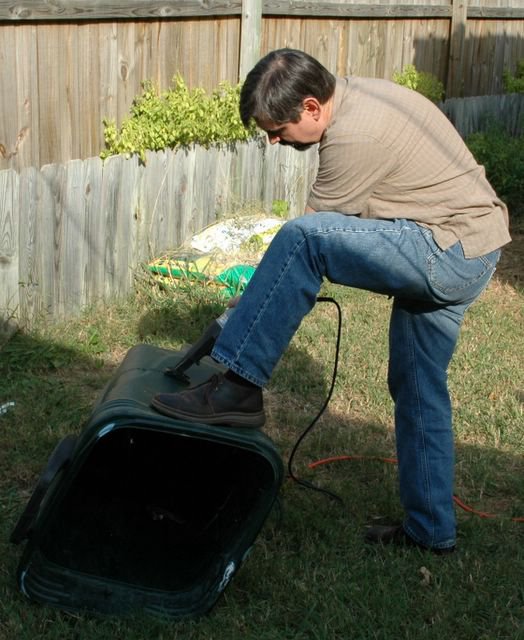

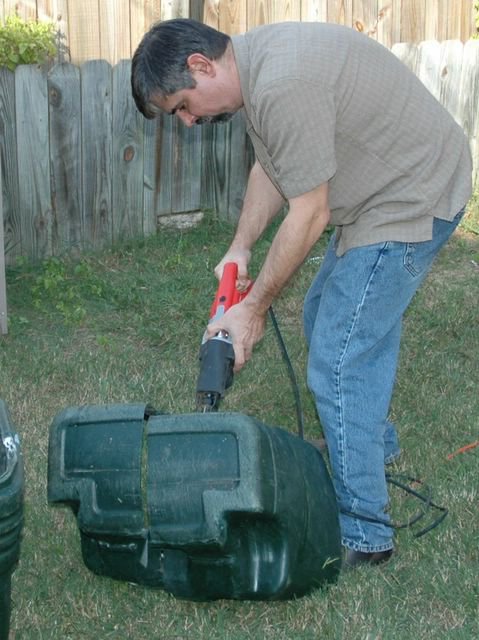
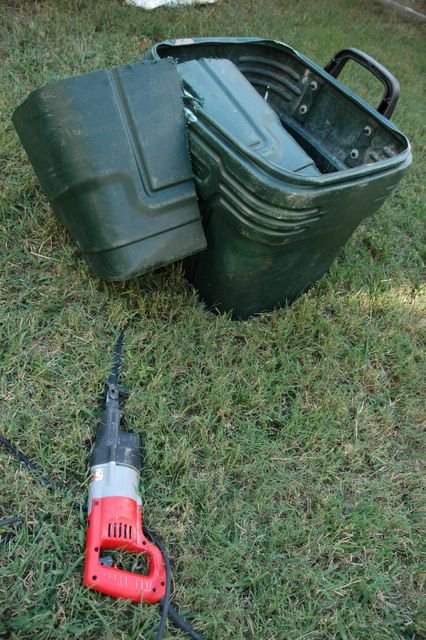
Today, I finally got around to it.

Saturday, October 29, 2005
Nothing New
Bane brings to mind that not much has changed when it comes to the American Soldier. For more than two hundred years, it has been de rigueur for the veteran soldiers to give the “fresh fish” a hard time.
“We were actually there for nearly a week, now, as I recall, maybe a little more, and those poor slobs suffered, as most of the time we were being blasted by a bad storm off the ocean, and these guys had no real woodcraft to speak of. Tim and I peeped out of our tents at them, as the storm hit, and the wind and rain began sweeping away their tents, and their gear. We would, between bouts of helpless laughter, and stopping to mix another drink, yell out helpful tips and encouragement to them.
"Fix that shitty fucking tent!" he would holler. Inspired, I yelled "You guys in the motherfuckin Navy? Cuz that sure looks like a fuckin sail, baby!" Then he would yell "Sure looks cold out there!"
”And so on.
”And we, warm and toasty, in our underwear, because it was nearly too hot inside, actually. We each had a candle light; that was something like a telescoping aluminum tube with a big white candle in it, and when you pulled it open, it exposed a glass window that had magnifying properties, and really lit up the tent so we could read one of several books we'd brought. And those candle thingies put out some heat, too. We hung them from little chains, over our respective areas.
”Then, at times, we would each pull out our respective cookware, our Sterno folding stoves and fuel, our spices and condiments, and prepare a feast. We each had a dozen eggs in plastic egg carriers, as well as several cases of C-Rats they'd dropped off with us, and a couple boxes of MRE's, and we feasted like kings. The smell of our cooking would waft down to those boys, and you would hear groaning. Their cook tent had become some fucked up, and getting hot meals in a hurricane, on flappy paper plates, is problematic. The smell of cooking...fresh eggs, bacon, and pan-biscuits, or pancakes, must have driven them to the edge of madness.
”They didn't mess with us because, well, we were grunts, and they knew it. Unless you've been around an active duty grunt, at the peak of his training, you might not understand. I never really got it myself, because I were one, and we all looked fairly normal to me, but others were scared shitless of us. Well, we'd have hurt or killed them for looking at us wrong, but really, we put our knife in one hole at a time just like everybody else, so I don't see the big deal.”
Nearly 150 years ago, during our own Civil War, the old guard acted pretty much the same (re: Wilbur Hinman, Corporal Si Klegg)
”The 200th was to lead the brigade that day, and as it marched past the old regiments the boys made the acquaintance of those who were to be their companions in camp and field… Listen to those ragged and depraved old soldiers as the men of the 200th Indiana, with their fresh faces, clean new clothes and burnished arms, go tramping by:
‘Here’s yer mules, boys! Look at the loads they’re packin’’
‘Fresh Fish!’
‘Thar ain’t no dew fell on ‘em yet.’
“… Si’s feelings were outraged. He wondered why men who were so lost to all decency were not court-martialed and shot. He straightened himself up and cast upon his tormentors a look of utter scorn. Sharp words of retort flew from his tongue, but they were lost in the chorus of wild yells of derision that greeted him.
“Better dry up, Si, said Shorty, them chaps is too many for ye. Wait till ye git a little more practice ‘fore ye try to talk to sich duffers ‘s they be.”
“We were actually there for nearly a week, now, as I recall, maybe a little more, and those poor slobs suffered, as most of the time we were being blasted by a bad storm off the ocean, and these guys had no real woodcraft to speak of. Tim and I peeped out of our tents at them, as the storm hit, and the wind and rain began sweeping away their tents, and their gear. We would, between bouts of helpless laughter, and stopping to mix another drink, yell out helpful tips and encouragement to them.
"Fix that shitty fucking tent!" he would holler. Inspired, I yelled "You guys in the motherfuckin Navy? Cuz that sure looks like a fuckin sail, baby!" Then he would yell "Sure looks cold out there!"
”And so on.
”And we, warm and toasty, in our underwear, because it was nearly too hot inside, actually. We each had a candle light; that was something like a telescoping aluminum tube with a big white candle in it, and when you pulled it open, it exposed a glass window that had magnifying properties, and really lit up the tent so we could read one of several books we'd brought. And those candle thingies put out some heat, too. We hung them from little chains, over our respective areas.
”Then, at times, we would each pull out our respective cookware, our Sterno folding stoves and fuel, our spices and condiments, and prepare a feast. We each had a dozen eggs in plastic egg carriers, as well as several cases of C-Rats they'd dropped off with us, and a couple boxes of MRE's, and we feasted like kings. The smell of our cooking would waft down to those boys, and you would hear groaning. Their cook tent had become some fucked up, and getting hot meals in a hurricane, on flappy paper plates, is problematic. The smell of cooking...fresh eggs, bacon, and pan-biscuits, or pancakes, must have driven them to the edge of madness.
”They didn't mess with us because, well, we were grunts, and they knew it. Unless you've been around an active duty grunt, at the peak of his training, you might not understand. I never really got it myself, because I were one, and we all looked fairly normal to me, but others were scared shitless of us. Well, we'd have hurt or killed them for looking at us wrong, but really, we put our knife in one hole at a time just like everybody else, so I don't see the big deal.”
Nearly 150 years ago, during our own Civil War, the old guard acted pretty much the same (re: Wilbur Hinman, Corporal Si Klegg)
”The 200th was to lead the brigade that day, and as it marched past the old regiments the boys made the acquaintance of those who were to be their companions in camp and field… Listen to those ragged and depraved old soldiers as the men of the 200th Indiana, with their fresh faces, clean new clothes and burnished arms, go tramping by:
‘Here’s yer mules, boys! Look at the loads they’re packin’’
‘Fresh Fish!’
‘Thar ain’t no dew fell on ‘em yet.’
“… Si’s feelings were outraged. He wondered why men who were so lost to all decency were not court-martialed and shot. He straightened himself up and cast upon his tormentors a look of utter scorn. Sharp words of retort flew from his tongue, but they were lost in the chorus of wild yells of derision that greeted him.
“Better dry up, Si, said Shorty, them chaps is too many for ye. Wait till ye git a little more practice ‘fore ye try to talk to sich duffers ‘s they be.”
Saturday, October 22, 2005
The Second Amendment Target in Arkansas
It's official. Dinosaur and I agree that the Second Amendment target should go to Resurgemus in Alaska. I kind of like that we're going through the "a's" first anyway. Arizona, Arkansas, Alaska... So, before I send it off, I thought I would tack it to my barn wall and take a picture of it along with my favorite '03 Springfield.

2nd Amendment Target on its Arkansas stop, touring America.
When it leaves here, it will also include a shot up target from the Arkansas Game and Fish Commission Firing range that we used this morning. The lucky recipient can choose between a target shot up by a .38 Chief's Special Airweight, or an M1 Garand.
Same rules apply as before, so pass it on!

2nd Amendment Target on its Arkansas stop, touring America.
When it leaves here, it will also include a shot up target from the Arkansas Game and Fish Commission Firing range that we used this morning. The lucky recipient can choose between a target shot up by a .38 Chief's Special Airweight, or an M1 Garand.
Same rules apply as before, so pass it on!
Friday, October 21, 2005
The Telltale Hand
Bane and Queenie have been posting ghost stories of late.
But, I'll tell you up front, I don't have anything as hair raising as those two, but I had a very eerie and supernatural experience once.
Lest you think this is a memory of a young boy and therefore suspect in its veracity, I must assure you that I was in my twenties when this occured.
I awoke in the middle of the night and had a strange sensation that I wasn't alone. In pitch black darkness I lay as still as possible listening.
Not hearing a noise, I started to turn and sit up. It was then that I felt it.
There was a ghastly, horrible hand on the pillow next to my head!
My fingers traced along its fingers, and I tentatively squeezed a couple of the fingertips, but with no reaction. For all practical purposes the hand was dead. And, for all I knew, detached from its original owner.
My heart was racing and my temples throbbing as I tried desperately to decide a course of action. At this point I was wide awake and holding the strange hand in mine.
In my terror I decided to fling the hand across the room and with a great heave I threw myself out of bed and sprawling onto the floor. It was at this point that I realized that I was holding my own hand, numb up to the shoulder from laying above my head on the pillow.
I guess I had fallen asleep that way.
But, I'll tell you up front, I don't have anything as hair raising as those two, but I had a very eerie and supernatural experience once.
Lest you think this is a memory of a young boy and therefore suspect in its veracity, I must assure you that I was in my twenties when this occured.
I awoke in the middle of the night and had a strange sensation that I wasn't alone. In pitch black darkness I lay as still as possible listening.
Not hearing a noise, I started to turn and sit up. It was then that I felt it.
There was a ghastly, horrible hand on the pillow next to my head!
My fingers traced along its fingers, and I tentatively squeezed a couple of the fingertips, but with no reaction. For all practical purposes the hand was dead. And, for all I knew, detached from its original owner.
My heart was racing and my temples throbbing as I tried desperately to decide a course of action. At this point I was wide awake and holding the strange hand in mine.
In my terror I decided to fling the hand across the room and with a great heave I threw myself out of bed and sprawling onto the floor. It was at this point that I realized that I was holding my own hand, numb up to the shoulder from laying above my head on the pillow.
I guess I had fallen asleep that way.
Monday, October 17, 2005
2nd Amendment Target Tour of the USA
This summary is not available. Please
click here to view the post.
Saturday, October 08, 2005
Davy Crockett vs. Welfare
I have always been an admirer of Davy Crockett, a man that put his "money where his mouth is". But I had not seen this before now. Hat tip to Difster for pointing me to it.
The story is excerpted from The Life of Colonel David Crockett by Edward S. Ellis:
Crockett was then the lion of Washington. I was a great admirer of his character, and, having several friends who were intimate with him, I found no difficulty in making his acquaintance. I was fascinated with him, and he seemed to take a fancy to me.
I was one day in the lobby of the House of Representatives when a bill was taken up appropriating money for the benefit of a widow of a distinguished naval officer. Several beautiful speeches had been made in its support – rather, as I thought, because it afforded the speakers a fine opportunity for display than from the necessity of convincing anybody, for it seemed to me that everybody favored it. The Speaker was just about to put the question when Crockett arose. Everybody expected, of course, that he was going to make one of his characteristic speeches in support of the bill. He commenced:
"Mr. Speaker – I have as much respect for the memory of the deceased, and as much sympathy for the sufferings of the living, if suffering there be, as any man in this House, but we must not permit our respect for the dead or our sympathy for a part of the living to lead us into an act of injustice to the balance of the living. I will not go into an argument to prove that Congress has no power to appropriate this money as an act of charity. Every member upon this floor knows it. We have the right, as individuals, to give away as much of our own money as we please in charity; but as members of Congress we have no right so to appropriate a dollar of the public money. Some eloquent appeals have been made to us upon the ground that it is a debt due the deceased. Mr. Speaker, the deceased lived long after the close of the war; he was in office to the day of his death, and I have never heard that the government was in arrears to him. This government can owe no debts but for services rendered, and at a stipulated price. If it is a debt, how much is it? Has it been audited, and the amount due ascertained? If it is a debt, this is not the place to present it for payment, or to have its merits examined. If it is a debt, we owe more than we can ever hope to pay, for we owe the widow of every soldier who fought in the War of 1812 precisely the same amount. There is a woman in my neighborhood, the widow of as gallant a man as ever shouldered a musket. He fell in battle. She is as good in every respect as this lady, and is as poor. She is earning her daily bread by her daily labor; but if I were to introduce a bill to appropriate five or ten thousand dollars for her benefit, I should be laughed at, and my bill would not get five votes in this House. There are thousands of widows in the country just such as the one I have spoken of, but we never hear of any of these large debts to them. Sir, this is no debt. The government did not owe it to the deceased when he was alive; it could not contract it after he died. I do not wish to be rude, but I must be plain. Every man in this House knows it is not a debt. We cannot, without the grossest corruption, appropriate this money as the payment of a debt. We have not the semblance of authority to appropriate it as a charity. Mr. Speaker, I have said we have the right to give as much of our own money as we please. I am the poorest man on this floor. I cannot vote for this bill, but I will give one week's pay to the object, and if every member of Congress will do the same, it will amount to more than the bill asks."
He took his seat. Nobody replied. The bill was put upon its passage, and, instead of passing unanimously, as was generally supposed, and as, no doubt, it would, but for that speech, it received but few votes, and, of course, was lost.
Like many other young men, and old ones, too, for that matter, who had not thought upon the subject, I desired the passage of the bill, and felt outraged at its defeat. I determined that I would persuade my friend Crockett to move a reconsideration the next day.
Previous engagements preventing me from seeing Crockett that night, I went early to his room the next morning and found him engaged in addressing and franking letters, a large pile of which lay upon his table.
I broke in upon him rather abruptly, by asking him what devil had possessed him to make that speech and defeat that bill yesterday. Without turning his head or looking up from his work, he replied:
"You see that I am very busy now; take a seat and cool yourself. I will be through in a few minutes, and then I will tell you all about it."
He continued his employment for about ten minutes, and when he had finished he turned to me and said:
"Now, sir, I will answer your question. But thereby hangs a tale, and one of considerable length, to which you will have to listen."
I listened, and this is the tale which I heard:
Several years ago I was one evening standing on the steps of the Capitol with some other members of Congress, when our attention was attracted by a great light over in Georgetown. It was evidently a large fire. We jumped into a hack and drove over as fast as we could. When we got there, I went to work, and I never worked as hard in my life as I did there for several hours. But, in spite of all that could be done, many houses were burned and many families made homeless, and, besides, some of them had lost all but the clothes they had on. The weather was very cold, and when I saw so many women and children suffering, I felt that something ought to be done for them, and everybody else seemed to feel the same way.
The next morning a bill was introduced appropriating $20,000 for their relief. We put aside all other business and rushed it through as soon as it could be done. I said everybody felt as I did. That was not quite so; for, though they perhaps sympathized as deeply with the sufferers as I did, there were a few of the members who did not think we had the right to indulge our sympathy or excite our charity at the expense of anybody but ourselves. They opposed the bill, and upon its passage demanded the yeas and nays. There were not enough of them to sustain the call, but many of us wanted our names to appear in favor of what we considered a praiseworthy measure, and we voted with them to sustain it. So the yeas and nays were recorded, and my name appeared on the journals in favor of the bill.
The next summer, when it began to be time to think about the election, I concluded I would take a scout around among the boys of my district. I had no opposition there, but, as the election was some time off, I did not know what might turn up, and I thought it was best to let the boys know that I had not forgot them, and that going to Congress had not made me too proud to go to see them.
So I put a couple of shirts and a few twists of tobacco into my saddlebags, and put out. I had been out about a week and had found things going very smoothly, when, riding one day in a part of my district in which I was more of a stranger than any other, I saw a man in a field plowing and coming toward the road. I gauged my gait so that we should meet as he came to the fence. As he came up I spoke to the man. He replied politely, but, as I thought, rather coldly, and was about turning his horse for another furrow when I said to him: "Don't be in such a hurry, my friend; I want to have a little talk with you, and get better acquainted."
He replied: "I am very busy, and have but little time to talk, but if it does not take too long, I will listen to what you have to say."
I began: "Well, friend, I am one of those unfortunate beings called candidates, and – "
"'Yes, I know you; you are Colonel Crockett. I have seen you once before, and voted for you the last time you were elected. I suppose you are out electioneering now, but you had better not waste your time or mine. I shall not vote for you again.'
This was a sockdolager... I begged him to tell me what was the matter.
"Well, Colonel, it is hardly worthwhile to waste time or words upon it. I do not see how it can be mended, but you gave a vote last winter which shows that either you have not capacity to understand the Constitution, or that you are wanting in honesty and firmness to be guided by it. In either case you are not the man to represent me. But I beg your pardon for expressing it in that way. I did not intend to avail myself of the privilege of the Constitution to speak plainly to a candidate for the purpose of insulting or wounding you. I intend by it only to say that your understanding of the Constitution is very different from mine; and I will say to you what, but for my rudeness, I should not have said, that I believe you to be honest. But an understanding of the Constitution different from mine I cannot overlook, because the Constitution, to be worth anything, must be held sacred, and rigidly observed in all its provisions. The man who wields power and misinterprets it is the more dangerous the more honest he is."
"I admit the truth of all you say, but there must be some mistake about it, for I do not remember that I gave any vote last winter upon any constitutional question."
"No, Colonel, there's no mistake. Though I live here in the backwoods and seldom go from home, I take the papers from Washington and read very carefully all the proceedings of Congress. My papers say that last winter you voted for a bill to appropriate $20,000 to some sufferers by a fire in Georgetown. Is that true?"
"Certainly it is, and I thought that was the last vote which anybody in the world would have found fault with."
"Well, Colonel, where do you find in the Constitution any authority to give away the public money in charity?"
Here was another sockdolager; for, when I began to think about it, I could not remember a thing in the Constitution that authorized it. I found I must take another tack, so I said:
"Well, my friend; I may as well own up. You have got me there. But certainly nobody will complain that a great and rich country like ours should give the insignificant sum of $20,000 to relieve its suffering women and children, particularly with a full and overflowing Treasury, and I am sure, if you had been there, you would have done just as I did."
"It is not the amount, Colonel, that I complain of; it is the principle. In the first place, the government ought to have in the Treasury no more than enough for its legitimate purposes. But that has nothing to do with the question. The power of collecting and disbursing money at pleasure is the most dangerous power that can be entrusted to man, particularly under our system of collecting revenue by a tariff, which reaches every man in the country, no matter how poor he may be, and the poorer he is the more he pays in proportion to his means. What is worse, it presses upon him without his knowledge where the weight centers, for there is not a man in the United States who can ever guess how much he pays to the government. So you see, that while you are contributing to relieve one, you are drawing it from thousands who are even worse off than he. If you had the right to give anything, the amount was simply a matter of discretion with you, and you had as much right to give $20,000,000 as $20,000. If you have the right to give to one, you have the right to give to all; and, as the Constitution neither defines charity nor stipulates the amount, you are at liberty to give to any and everything which you may believe, or profess to believe, is a charity, and to any amount you may think proper. You will very easily perceive what a wide door this would open for fraud and corruption and favoritism, on the one hand, and for robbing the people on the other. No, Colonel, Congress has no right to give charity. Individual members may give as much of their own money as they please, but they have no right to touch a dollar of the public money for that purpose. If twice as many houses had been burned in this county as in Georgetown, neither you nor any other member of Congress would have thought of appropriating a dollar for our relief. There are about two hundred and forty members of Congress. If they had shown their sympathy for the sufferers by contributing each one week's pay, it would have made over $13,000. There are plenty of wealthy men in and around Washington who could have given $20,000 without depriving themselves of even a luxury of life. The Congressmen chose to keep their own money, which, if reports be true, some of them spend not very creditably; and the people about Washington, no doubt, applauded you for relieving them from the necessity of giving by giving what was not yours to give. The people have delegated to Congress, by the Constitution, the power to do certain things. To do these, it is authorized to collect and pay moneys, and for nothing else. Everything beyond this is usurpation, and a violation of the Constitution."
I have given you an imperfect account of what he said. Long before he was through, I was convinced that I had done wrong. He wound up by saying:
"So you see, Colonel, you have violated the Constitution in what I consider a vital point. It is a precedent fraught with danger to the country, for when Congress once begins to stretch its power beyond the limits of the Constitution, there is no limit to it, and no security for the people. I have no doubt you acted honestly, but that does not make it any better, except as far as you are personally concerned, and you see that I cannot vote for you."
I tell you I felt streaked. I saw if I should have opposition, and this man should go talking, he would set others to talking, and in that district I was a gone fawn-skin. I could not answer him, and the fact is, I did not want to. But I must satisfy him, and I said to him:
"Well, my friend, you hit the nail upon the head when you said I had not sense enough to understand the Constitution. I intended to be guided by it, and thought I had studied it full. I have heard many speeches in Congress about the powers of Congress, but what you have said there at your plow has got more hard, sound sense in it than all the fine speeches I ever heard. If I had ever taken the view of it that you have, I would have put my head into the fire before I would have given that vote; and if you will forgive me and vote for me again, if I ever vote for another unconstitutional law I wish I may be shot."
He laughingly replied:
"Yes, Colonel, you have sworn to that once before, but I will trust you again upon one condition. You say that you are convinced that your vote was wrong. Your acknowledgment of it will do more good than beating you for it. If, as you go around the district, you will tell people about this vote, and that you are satisfied it was wrong, I will not only vote for you, but will do what I can to keep down opposition, and, perhaps, I may exert some little influence in that way."
"If I don't," said I, "I wish I may be shot; and to convince you that I am in earnest in what I say, I will come back this way in a week or ten days, and if you will get up a gathering of the people, I will make a speech to them. Get up a barbecue, and I will pay for it."
"No, Colonel, we are not rich people in this section, but we have plenty of provisions to contribute for a barbecue, and some to spare for those who have none. The push of crops will be over in a few days, and we can then afford a day for a barbecue. This is Thursday; I will see to getting it up on Saturday week. Come to my house on Friday, and we will go together, and I promise you a very respectable crowd to see and hear you."
"Well, I will be here. But one thing more before I say good-bye. I must know your name."
"My name is Bunce."
"Not Horatio Bunce?"
"Yes."
"Well, Mr. Bunce, I never saw you before, though you say you have seen me; but I know you very well. I am glad I have met you, and very proud that I may hope to have you for my friend. You must let me shake your hand before I go."
We shook hands and parted.
It was one of the luckiest hits of my life that I met him. He mingled but little with the public, but was widely known for his remarkable intelligence and incorruptible integrity, and for a heart brimful and running over with kindness and benevolence, which showed themselves not only in words but in acts. He was the oracle of the whole country around him, and his fame had extended far beyond the circle of his immediate acquaintance. Though I had never met him before, I had heard much of him, and but for this meeting it is very likely I should have had opposition, and had been beaten. One thing is very certain, no man could now stand up in that district under such a vote.
At the appointed time I was at his house, having told our conversation to every crowd I had met, and to every man I stayed all night with, and I found that it gave the people an interest and a confidence in me stronger than I had ever seen manifested before.
Though I was considerably fatigued when I reached his house, and, under ordinary circumstances, should have gone early to bed, I kept him up until midnight, talking about the principles and affairs of government, and got more real, true knowledge of them than I had got all my life before.
I have told you Mr. Bunce converted me politically. He came nearer converting me religiously than I had ever been before. He did not make a very good Christian of me, as you know; but he has wrought upon my mind a conviction of the truth of Christianity, and upon my feelings a reverence for its purifying and elevating power such as I had never felt before.
I have known and seen much of him since, for I respect him – no, that is not the word – I reverence and love him more than any living man, and I go to see him two or three times every year; and I will tell you, sir, if everyone who professes to be a Christian lived and acted and enjoyed it as he does, the religion of Christ would take the world by storm.
But to return to my story. The next morning we went to the barbecue, and, to my surprise, found about a thousand men there. I met a good many whom I had not known before, and they and my friend introduced me around until I had got pretty well acquainted – at least, they all knew me.
In due time notice was given that I would speak to them. They gathered around a stand that had been erected. I opened my speech by saying:
"Fellow citizens – I present myself before you today feeling like a new man. My eyes have lately been opened to truths which ignorance or prejudice, or both, had heretofore hidden from my view. I feel that I can today offer you the ability to render you more valuable service than I have ever been able to render before. I am here today more for the purpose of acknowledging my error than to seek your votes. That I should make this acknowledgment is due to myself as well as to you. Whether you will vote for me is a matter for your consideration only."
I went on to tell them about the fire and my vote for the appropriation as I have told it to you, and then told them why I was satisfied it was wrong. I closed by saying:
"And now, fellow citizens, it remains only for me to tell you that the most of the speech you have listened to with so much interest was simply a repetition of the arguments by which your neighbor, Mr. Bunce, convinced me of my error.
"It is the best speech I ever made in my life, but he is entitled to the credit of it. And now I hope he is satisfied with his convert and that he will get up here and tell you so."
He came upon the stand and said:
"Fellow citizens – It affords me great pleasure to comply with the request of Colonel Crockett. I have always considered him a thoroughly honest man, and I am satisfied that he will faithfully perform all that he has promised you today."
He went down, and there went up from the crowd such a shout for Davy Crockett as his name never called forth before.
I am not much given to tears, but I was taken with a choking then and felt some big drops rolling down my cheeks. And I tell you now that the remembrance of those few words spoken by such a man, and the honest, hearty shout they produced, is worth more to me than all the honors I have received and all the reputation I have ever made, or ever shall make, as a member of Congress.
"Now, Sir," concluded Crockett, "you know why I made that speech yesterday. I have had several thousand copies of it printed and was directing them to my constituents when you came in.
"There is one thing now to which I will call your attention. You remember that I proposed to give a week's pay. There are in that House many very wealthy men – men who think nothing of spending a week's pay, or a dozen of them for a dinner or a wine party when they have something to accomplish by it. Some of those same men made beautiful speeches upon the great debt of gratitude which the country owed the deceased – a debt which could not be paid by money, particularly so insignificant a sum as $10,000, when weighed against the honor of the nation. Yet not one of them responded to my proposition. Money with them is nothing but trash when it is to come out of the people. But it is the one great thing for which most of them are striving, and many of them sacrifice honor, integrity, and justice to obtain it."
The story is excerpted from The Life of Colonel David Crockett by Edward S. Ellis:
Crockett was then the lion of Washington. I was a great admirer of his character, and, having several friends who were intimate with him, I found no difficulty in making his acquaintance. I was fascinated with him, and he seemed to take a fancy to me.
I was one day in the lobby of the House of Representatives when a bill was taken up appropriating money for the benefit of a widow of a distinguished naval officer. Several beautiful speeches had been made in its support – rather, as I thought, because it afforded the speakers a fine opportunity for display than from the necessity of convincing anybody, for it seemed to me that everybody favored it. The Speaker was just about to put the question when Crockett arose. Everybody expected, of course, that he was going to make one of his characteristic speeches in support of the bill. He commenced:
"Mr. Speaker – I have as much respect for the memory of the deceased, and as much sympathy for the sufferings of the living, if suffering there be, as any man in this House, but we must not permit our respect for the dead or our sympathy for a part of the living to lead us into an act of injustice to the balance of the living. I will not go into an argument to prove that Congress has no power to appropriate this money as an act of charity. Every member upon this floor knows it. We have the right, as individuals, to give away as much of our own money as we please in charity; but as members of Congress we have no right so to appropriate a dollar of the public money. Some eloquent appeals have been made to us upon the ground that it is a debt due the deceased. Mr. Speaker, the deceased lived long after the close of the war; he was in office to the day of his death, and I have never heard that the government was in arrears to him. This government can owe no debts but for services rendered, and at a stipulated price. If it is a debt, how much is it? Has it been audited, and the amount due ascertained? If it is a debt, this is not the place to present it for payment, or to have its merits examined. If it is a debt, we owe more than we can ever hope to pay, for we owe the widow of every soldier who fought in the War of 1812 precisely the same amount. There is a woman in my neighborhood, the widow of as gallant a man as ever shouldered a musket. He fell in battle. She is as good in every respect as this lady, and is as poor. She is earning her daily bread by her daily labor; but if I were to introduce a bill to appropriate five or ten thousand dollars for her benefit, I should be laughed at, and my bill would not get five votes in this House. There are thousands of widows in the country just such as the one I have spoken of, but we never hear of any of these large debts to them. Sir, this is no debt. The government did not owe it to the deceased when he was alive; it could not contract it after he died. I do not wish to be rude, but I must be plain. Every man in this House knows it is not a debt. We cannot, without the grossest corruption, appropriate this money as the payment of a debt. We have not the semblance of authority to appropriate it as a charity. Mr. Speaker, I have said we have the right to give as much of our own money as we please. I am the poorest man on this floor. I cannot vote for this bill, but I will give one week's pay to the object, and if every member of Congress will do the same, it will amount to more than the bill asks."
He took his seat. Nobody replied. The bill was put upon its passage, and, instead of passing unanimously, as was generally supposed, and as, no doubt, it would, but for that speech, it received but few votes, and, of course, was lost.
Like many other young men, and old ones, too, for that matter, who had not thought upon the subject, I desired the passage of the bill, and felt outraged at its defeat. I determined that I would persuade my friend Crockett to move a reconsideration the next day.
Previous engagements preventing me from seeing Crockett that night, I went early to his room the next morning and found him engaged in addressing and franking letters, a large pile of which lay upon his table.
I broke in upon him rather abruptly, by asking him what devil had possessed him to make that speech and defeat that bill yesterday. Without turning his head or looking up from his work, he replied:
"You see that I am very busy now; take a seat and cool yourself. I will be through in a few minutes, and then I will tell you all about it."
He continued his employment for about ten minutes, and when he had finished he turned to me and said:
"Now, sir, I will answer your question. But thereby hangs a tale, and one of considerable length, to which you will have to listen."
I listened, and this is the tale which I heard:
Several years ago I was one evening standing on the steps of the Capitol with some other members of Congress, when our attention was attracted by a great light over in Georgetown. It was evidently a large fire. We jumped into a hack and drove over as fast as we could. When we got there, I went to work, and I never worked as hard in my life as I did there for several hours. But, in spite of all that could be done, many houses were burned and many families made homeless, and, besides, some of them had lost all but the clothes they had on. The weather was very cold, and when I saw so many women and children suffering, I felt that something ought to be done for them, and everybody else seemed to feel the same way.
The next morning a bill was introduced appropriating $20,000 for their relief. We put aside all other business and rushed it through as soon as it could be done. I said everybody felt as I did. That was not quite so; for, though they perhaps sympathized as deeply with the sufferers as I did, there were a few of the members who did not think we had the right to indulge our sympathy or excite our charity at the expense of anybody but ourselves. They opposed the bill, and upon its passage demanded the yeas and nays. There were not enough of them to sustain the call, but many of us wanted our names to appear in favor of what we considered a praiseworthy measure, and we voted with them to sustain it. So the yeas and nays were recorded, and my name appeared on the journals in favor of the bill.
The next summer, when it began to be time to think about the election, I concluded I would take a scout around among the boys of my district. I had no opposition there, but, as the election was some time off, I did not know what might turn up, and I thought it was best to let the boys know that I had not forgot them, and that going to Congress had not made me too proud to go to see them.
So I put a couple of shirts and a few twists of tobacco into my saddlebags, and put out. I had been out about a week and had found things going very smoothly, when, riding one day in a part of my district in which I was more of a stranger than any other, I saw a man in a field plowing and coming toward the road. I gauged my gait so that we should meet as he came to the fence. As he came up I spoke to the man. He replied politely, but, as I thought, rather coldly, and was about turning his horse for another furrow when I said to him: "Don't be in such a hurry, my friend; I want to have a little talk with you, and get better acquainted."
He replied: "I am very busy, and have but little time to talk, but if it does not take too long, I will listen to what you have to say."
I began: "Well, friend, I am one of those unfortunate beings called candidates, and – "
"'Yes, I know you; you are Colonel Crockett. I have seen you once before, and voted for you the last time you were elected. I suppose you are out electioneering now, but you had better not waste your time or mine. I shall not vote for you again.'
This was a sockdolager... I begged him to tell me what was the matter.
"Well, Colonel, it is hardly worthwhile to waste time or words upon it. I do not see how it can be mended, but you gave a vote last winter which shows that either you have not capacity to understand the Constitution, or that you are wanting in honesty and firmness to be guided by it. In either case you are not the man to represent me. But I beg your pardon for expressing it in that way. I did not intend to avail myself of the privilege of the Constitution to speak plainly to a candidate for the purpose of insulting or wounding you. I intend by it only to say that your understanding of the Constitution is very different from mine; and I will say to you what, but for my rudeness, I should not have said, that I believe you to be honest. But an understanding of the Constitution different from mine I cannot overlook, because the Constitution, to be worth anything, must be held sacred, and rigidly observed in all its provisions. The man who wields power and misinterprets it is the more dangerous the more honest he is."
"I admit the truth of all you say, but there must be some mistake about it, for I do not remember that I gave any vote last winter upon any constitutional question."
"No, Colonel, there's no mistake. Though I live here in the backwoods and seldom go from home, I take the papers from Washington and read very carefully all the proceedings of Congress. My papers say that last winter you voted for a bill to appropriate $20,000 to some sufferers by a fire in Georgetown. Is that true?"
"Certainly it is, and I thought that was the last vote which anybody in the world would have found fault with."
"Well, Colonel, where do you find in the Constitution any authority to give away the public money in charity?"
Here was another sockdolager; for, when I began to think about it, I could not remember a thing in the Constitution that authorized it. I found I must take another tack, so I said:
"Well, my friend; I may as well own up. You have got me there. But certainly nobody will complain that a great and rich country like ours should give the insignificant sum of $20,000 to relieve its suffering women and children, particularly with a full and overflowing Treasury, and I am sure, if you had been there, you would have done just as I did."
"It is not the amount, Colonel, that I complain of; it is the principle. In the first place, the government ought to have in the Treasury no more than enough for its legitimate purposes. But that has nothing to do with the question. The power of collecting and disbursing money at pleasure is the most dangerous power that can be entrusted to man, particularly under our system of collecting revenue by a tariff, which reaches every man in the country, no matter how poor he may be, and the poorer he is the more he pays in proportion to his means. What is worse, it presses upon him without his knowledge where the weight centers, for there is not a man in the United States who can ever guess how much he pays to the government. So you see, that while you are contributing to relieve one, you are drawing it from thousands who are even worse off than he. If you had the right to give anything, the amount was simply a matter of discretion with you, and you had as much right to give $20,000,000 as $20,000. If you have the right to give to one, you have the right to give to all; and, as the Constitution neither defines charity nor stipulates the amount, you are at liberty to give to any and everything which you may believe, or profess to believe, is a charity, and to any amount you may think proper. You will very easily perceive what a wide door this would open for fraud and corruption and favoritism, on the one hand, and for robbing the people on the other. No, Colonel, Congress has no right to give charity. Individual members may give as much of their own money as they please, but they have no right to touch a dollar of the public money for that purpose. If twice as many houses had been burned in this county as in Georgetown, neither you nor any other member of Congress would have thought of appropriating a dollar for our relief. There are about two hundred and forty members of Congress. If they had shown their sympathy for the sufferers by contributing each one week's pay, it would have made over $13,000. There are plenty of wealthy men in and around Washington who could have given $20,000 without depriving themselves of even a luxury of life. The Congressmen chose to keep their own money, which, if reports be true, some of them spend not very creditably; and the people about Washington, no doubt, applauded you for relieving them from the necessity of giving by giving what was not yours to give. The people have delegated to Congress, by the Constitution, the power to do certain things. To do these, it is authorized to collect and pay moneys, and for nothing else. Everything beyond this is usurpation, and a violation of the Constitution."
I have given you an imperfect account of what he said. Long before he was through, I was convinced that I had done wrong. He wound up by saying:
"So you see, Colonel, you have violated the Constitution in what I consider a vital point. It is a precedent fraught with danger to the country, for when Congress once begins to stretch its power beyond the limits of the Constitution, there is no limit to it, and no security for the people. I have no doubt you acted honestly, but that does not make it any better, except as far as you are personally concerned, and you see that I cannot vote for you."
I tell you I felt streaked. I saw if I should have opposition, and this man should go talking, he would set others to talking, and in that district I was a gone fawn-skin. I could not answer him, and the fact is, I did not want to. But I must satisfy him, and I said to him:
"Well, my friend, you hit the nail upon the head when you said I had not sense enough to understand the Constitution. I intended to be guided by it, and thought I had studied it full. I have heard many speeches in Congress about the powers of Congress, but what you have said there at your plow has got more hard, sound sense in it than all the fine speeches I ever heard. If I had ever taken the view of it that you have, I would have put my head into the fire before I would have given that vote; and if you will forgive me and vote for me again, if I ever vote for another unconstitutional law I wish I may be shot."
He laughingly replied:
"Yes, Colonel, you have sworn to that once before, but I will trust you again upon one condition. You say that you are convinced that your vote was wrong. Your acknowledgment of it will do more good than beating you for it. If, as you go around the district, you will tell people about this vote, and that you are satisfied it was wrong, I will not only vote for you, but will do what I can to keep down opposition, and, perhaps, I may exert some little influence in that way."
"If I don't," said I, "I wish I may be shot; and to convince you that I am in earnest in what I say, I will come back this way in a week or ten days, and if you will get up a gathering of the people, I will make a speech to them. Get up a barbecue, and I will pay for it."
"No, Colonel, we are not rich people in this section, but we have plenty of provisions to contribute for a barbecue, and some to spare for those who have none. The push of crops will be over in a few days, and we can then afford a day for a barbecue. This is Thursday; I will see to getting it up on Saturday week. Come to my house on Friday, and we will go together, and I promise you a very respectable crowd to see and hear you."
"Well, I will be here. But one thing more before I say good-bye. I must know your name."
"My name is Bunce."
"Not Horatio Bunce?"
"Yes."
"Well, Mr. Bunce, I never saw you before, though you say you have seen me; but I know you very well. I am glad I have met you, and very proud that I may hope to have you for my friend. You must let me shake your hand before I go."
We shook hands and parted.
It was one of the luckiest hits of my life that I met him. He mingled but little with the public, but was widely known for his remarkable intelligence and incorruptible integrity, and for a heart brimful and running over with kindness and benevolence, which showed themselves not only in words but in acts. He was the oracle of the whole country around him, and his fame had extended far beyond the circle of his immediate acquaintance. Though I had never met him before, I had heard much of him, and but for this meeting it is very likely I should have had opposition, and had been beaten. One thing is very certain, no man could now stand up in that district under such a vote.
At the appointed time I was at his house, having told our conversation to every crowd I had met, and to every man I stayed all night with, and I found that it gave the people an interest and a confidence in me stronger than I had ever seen manifested before.
Though I was considerably fatigued when I reached his house, and, under ordinary circumstances, should have gone early to bed, I kept him up until midnight, talking about the principles and affairs of government, and got more real, true knowledge of them than I had got all my life before.
I have told you Mr. Bunce converted me politically. He came nearer converting me religiously than I had ever been before. He did not make a very good Christian of me, as you know; but he has wrought upon my mind a conviction of the truth of Christianity, and upon my feelings a reverence for its purifying and elevating power such as I had never felt before.
I have known and seen much of him since, for I respect him – no, that is not the word – I reverence and love him more than any living man, and I go to see him two or three times every year; and I will tell you, sir, if everyone who professes to be a Christian lived and acted and enjoyed it as he does, the religion of Christ would take the world by storm.
But to return to my story. The next morning we went to the barbecue, and, to my surprise, found about a thousand men there. I met a good many whom I had not known before, and they and my friend introduced me around until I had got pretty well acquainted – at least, they all knew me.
In due time notice was given that I would speak to them. They gathered around a stand that had been erected. I opened my speech by saying:
"Fellow citizens – I present myself before you today feeling like a new man. My eyes have lately been opened to truths which ignorance or prejudice, or both, had heretofore hidden from my view. I feel that I can today offer you the ability to render you more valuable service than I have ever been able to render before. I am here today more for the purpose of acknowledging my error than to seek your votes. That I should make this acknowledgment is due to myself as well as to you. Whether you will vote for me is a matter for your consideration only."
I went on to tell them about the fire and my vote for the appropriation as I have told it to you, and then told them why I was satisfied it was wrong. I closed by saying:
"And now, fellow citizens, it remains only for me to tell you that the most of the speech you have listened to with so much interest was simply a repetition of the arguments by which your neighbor, Mr. Bunce, convinced me of my error.
"It is the best speech I ever made in my life, but he is entitled to the credit of it. And now I hope he is satisfied with his convert and that he will get up here and tell you so."
He came upon the stand and said:
"Fellow citizens – It affords me great pleasure to comply with the request of Colonel Crockett. I have always considered him a thoroughly honest man, and I am satisfied that he will faithfully perform all that he has promised you today."
He went down, and there went up from the crowd such a shout for Davy Crockett as his name never called forth before.
I am not much given to tears, but I was taken with a choking then and felt some big drops rolling down my cheeks. And I tell you now that the remembrance of those few words spoken by such a man, and the honest, hearty shout they produced, is worth more to me than all the honors I have received and all the reputation I have ever made, or ever shall make, as a member of Congress.
"Now, Sir," concluded Crockett, "you know why I made that speech yesterday. I have had several thousand copies of it printed and was directing them to my constituents when you came in.
"There is one thing now to which I will call your attention. You remember that I proposed to give a week's pay. There are in that House many very wealthy men – men who think nothing of spending a week's pay, or a dozen of them for a dinner or a wine party when they have something to accomplish by it. Some of those same men made beautiful speeches upon the great debt of gratitude which the country owed the deceased – a debt which could not be paid by money, particularly so insignificant a sum as $10,000, when weighed against the honor of the nation. Yet not one of them responded to my proposition. Money with them is nothing but trash when it is to come out of the people. But it is the one great thing for which most of them are striving, and many of them sacrifice honor, integrity, and justice to obtain it."
Friday, October 07, 2005
There's No Place Like Home...
My refugees have departed. Off to sleep in their own beds again. We know they have electricity and hope the water is back up by now.
As for me, I really enjoyed having that time with my sister and her family. Now that they know how to get to my house, maybe they'll come visit more often...
Oh, and I learned last night that I am the proud winner of the Second Amendment Target and will be the third stop on its tour of America. If you don't know what I'm talking about, stay tuned... you too may be a winner!
As for me, I really enjoyed having that time with my sister and her family. Now that they know how to get to my house, maybe they'll come visit more often...
Oh, and I learned last night that I am the proud winner of the Second Amendment Target and will be the third stop on its tour of America. If you don't know what I'm talking about, stay tuned... you too may be a winner!
Thursday, September 29, 2005
The Mountains
Took the refugees to the mountains today. The weather couldn't have been more accommodating. Temperatures in the seventies and perfectly blue skies. We hiked to the bottom of Cedar Falls, a true shock and awe for flatlanders.

Cedar Falls
All were suitably impressed.

Cedar Falls
All were suitably impressed.
Subscribe to:
Posts (Atom)